Pages

Showing posts with label Writing. Show all posts

Thursday, 29 September 2022

Who is at fault? The Three Little Pigs or the Big Bad Wolf by Aiden N


LI: To make an informed opinion.

This week we have been learning about bias. Bias can be objective which means explaining both sides of the story but with two different perspectives of the story or subjective which means being influenced by past experience. We looked at the same story from different perspectives. A perspective is someone's perspective on what happened in a situation. After reading and summarising both texts we thought about and talked about the facts to help us make an informed opinion. 

Xavier and I found this interesting because we had to look deeper into information to find out who was at fault. Something I found interesting was that, the only reason why the big bad wolf came to pigs houses was because he wanted a cup of sugar for his grandma’s birthday cake.

Monday, 27 June 2022

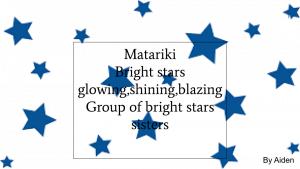
Matariki Cinquain Poem by Aiden

LI: to write a cinquain poem to describe Matariki 


Our challenge today was to write a cinquain poem to help us strengthen our connections to description that describes Matariki. A cinquain poem has 5 lines. Each line has a different purpose. Line 1 is a noun which is a name. Line 2 has 2 adjectives that describe the noun. Line 3 has 3 verbs that end in ‘ing’ and describe the actions. Line 4 is a noun phrase which is a group of words (not a sentence) that go together to describe the noun. Line 5 is a synonym which is a word with a similar meaning to the noun. 

Cinquain Poem by Fotu


This week we have been exploring the world of Matariki. Our challenge today was to write a cinquain poem to help us strengthen our connections to description that describes Matariki. A cinquain poem has 5 lines. Each line has a different purpose. Line 1 is a noun which is a name. Line 2 has 2 adjectives that describe the noun. Line 3 has 3 verbs that end in ‘ing’ and describe the actions. Line 4 is a noun phrase which is a group of words (not a sentence) that go together to describe the noun. Line 5 is a synonym which is a word with a similar meaning to the noun.

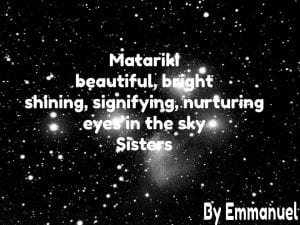
Cinquain Poem by Emmanuel

LI: To write a cinquain poem to describe Matariki.


This week we have been exploring the world of Matariki. Our challenge today was to write a cinquain poem to help us strengthen our connections to a description that describes Matariki. A cinquain poem has 5 lines. Each line has a different purpose. Line 1 is a noun which is a name. Line 2 has 2 adjectives that describe the noun. Line 3 has 3 verbs that end in ‘ing’ and describe the actions. Line 4 is a noun phrase which is a group of words (not a sentence) that go together to describe the noun. Line 5 is a synonym which is a word with a similar meaning to the noun.

Cinquain Poem by Mahdi

 LI: To write a cinquain poem to describe Matariki 


Our challenge today was to write a cinquain poem to help us strengthen our connections to a description that describes Matariki. A cinquain poem has 5 lines. Each line has a different purpose. Line 1 is a noun which is a name. Line 2 has 2 adjectives that describe the noun. Line 3 has 3 verbs that end in ‘ing’ and describe the actions. Line 4 is a noun phrase which is a group of words (not a sentence) that go together to describe the noun. Line 5 is a synonym which is a word with a similar meaning to the noun. This activity was helpful because I can use it to describe different people or fictional characters.

Ancestor Poem by Te Raumati

 LI: To create a poem that connects with your ancestors, by asking questions

This week we have been learning about Matariki, and one of the things we have learnt is that reflecting is an important part when celebrating Matariki. A way we reflected was by writing a poem that is addressed to our ancestors. The way that we wrote the poem was by asking 5 questions about their lifetime. The questions that were used had to include powerful words to express the mood in that questions. As an option, we could write the poem in our own language because it shows respect towards their culture. If they were to do this, they would have to have an english version so others can understand. We also needed to draw a picture that relates with a younger person reconnecting with an adult. I found this activity interesting because I was able to learn new vocabulary and how to write a different poem.

Cinquain Poem by Te Raumati

LI: To write a cinquain poem to describe Matariki

Our challenge today was to write a cinquain poem to help us strengthen our connections to description that describes Matariki. A cinquain poem has 5 lines. Each line has a different purpose. Line 1 is a noun which is a name. Line 2 has 2 adjectives that describe the noun. Line 3 has 3 verbs that end in ‘ing’ and describe the actions. Line 4 is a noun phrase which is a group of words (not a sentence) that go together to describe the noun. Line 5 is a synonym which is a word with a similar meaning to the noun.

Cinquain Poem by Kahu


This week we have been exploring the world of Matariki. Our challenge today was to write a cinquain poem to help us strengthen our connections to description that describes Matariki. A cinquain poem has 5 lines. Each line has a different purpose. Line 1 is a noun which is a name. Line 2 has 2 adjectives that describe the noun. Line 3 has 3 verbs that end in ‘ing’ and describe the actions. Line 4 is a noun phrase which is a group of words (not a sentence) that go together to describe the noun. Line 5 is a synonym which is a word with a similar meaning to the noun.

Cinquain Poem by Xavier

LI: To write a cinquain poem to describe Matariki


This week we have been exploring the world of Matariki. Our challenge today was to write a cinquain poem to help us strengthen our connections to description that describes Matariki. A cinquain poem has 5 lines. Each line has a different purpose. Line 1 is a noun which is a name. Line 2 has 2 adjectives that describe the noun. Line 3 has 3 verbs that end in ‘ing’ and describe the actions. Line 4 is a noun phrase which is a group of words (not a sentence) that go together to describe the noun. Line 5 is a synonym which is a word with a similar meaning to the noun.

Cinquain Poem by Hector


LI: To write a Cinquain poem to describe Matariki

This week we have been exploring the world of Matariki. Our challenge today was to write a cinquain poem to help us strengthen our connections to description that describes Matariki. A cinquain poem has 5 lines. Each line has a different purpose. Line 1 is a noun which is a name. Line 2 has 2 adjectives that describe the noun. Line 3 has 3 verbs that end in ‘ing’ and describe the actions. Line 4 is a noun phrase which is a group of words (not a sentence) that go together to describe the noun. Line 5 is a synonym which is a word with a similar meaning to the noun.    

Tuesday, 9 March 2021

Research: Diana

 LI: To make a DLO to show information about Pandas.


Today I made a DLO to show about the Giant pandas. First we opened a google draw and then we made it interesting by adding the information about the giant pandas. After I added a picture of the panda. I enjoyed it because this activity taught and showed me more facts and information about the giant pandas. 


Giant Panda Research: Fau, Leon and Chris

 L.I:  To use our smart searching skills to find information about the giant panda 


 Our activity for today was researching about Giant pandas.  We created paragraphs to inform interesting facts and things about giant pandas. In our task we had to write down information about pandas on a note sheet. After writing down our information we wrote down paragraphs. The paragraphs was basically used to sum up our information that we wrote down on our note sheet. After writing everything down we created a DLO which had all the information about Giant pandas.  We found this activity interesting and also gave us the opportunity to find out more about Giant Pandas and how they survive in the wild.  One interesting fact I learnt about Giant pandas is that they consume around 44lb (20kgs) of bamboo. 


Giant Panda Research | Writing: Juel, Sulia and Farzana

LI: to use our smart searching skills to find information about the giant panda.


Our focus for this challenge was based on writing TEEL paragraphs about giant pandas. After using our smart searching skills, we used the TEEL structure in order to write paragraphs. TEEL is the acronym for: topic sentence, elaborate, evidence and link sentence. 

First we researched about giant pandas and found information about them. After this, we made bullet point notes including the main points of our research. These notes helped create sentences with all the main ideas and made it understandable. 

After making the notes we started writing our TEEL paragraphs. TEEL paragraphs help us to expand our knowledge/ideas and formulate our thinking into informational pieces of text. 

We found this activity very enjoyable because we collaborated together to find out shocking information about pandas. One thing I learnt from this activity was that giant pandas are very close to extinction. 

Monday, 1 March 2021

TEEL Paragraphs: Tanisha

LI: To use powerful words and transitional vocabulary to make our writing more interesting


This week we have been learning to use transitional vocabulary to help us link ideas between the sentences in our paragraph. The transitional words are like the doors we walk through and to show how this works in writing we have highlighted them. I enjoyed this activity because we got to try using new words in our writing and we worked collaboratively so we got to share our ideas.


T.E.E.L Paragraph: Heavenly

L.I: To understand how TEEL paragraphs can help us structure our information and ideas in a paragraph.


We use paragraphs in our writing to expand on an idea. In LS2 we use the TEEL acronym (title, elaborate, evidence and link) to help us structure our thinking. The example on my DLO shows what Topic Sentence means , Elaborate,Evidence and Linking how and why I found this task really fun and enjoying to do as I learned new things and understood what to do.  I also wrote in my DLO what TEEL means and what it does to help us understand writing paragraphs. 


Thursday, 28 May 2020

Taonga Poems

LI: To write a poem to describe ancestors by using the literary devices of alliteration, onomatopoeia, metaphor, simile and rhyme. 


LS2 have been thinking about how literary devices and figurative language can paint a clear picture with words. To strengthen our connections to the learning we tapped into our culture and family connections. 


Tuesday, 9 April 2019

Why kokako lodge is a great place for year 7/8 to go to camp by Joel


This Week in Writing Sandra, Miiana, Fui and I worked collaboratively together  to create a 50 word summary and a idea list. Together in our group of 4 we created a screencastify explaining our ideas about why Kokako Lodge is  a great place for year 7/8 students to go to camp. This gives kids the opportunity to get involved in each activity. Our ideas helped us create a digital version of our response to Siri. We listed all of our ideas down on pieces of sheet. So we collaboratively combined all of our ideas into a video. 

Stretching Sentences by Aung Naing


On Wednesday we played a game called 2 words 1 minute. In this game there are two words and you have to make sentences using those two words in 1 minute. After we had one game we made a DLO were we to explain how to stretch sentences with the 5 w's and the H, to make a better sentence and add more detail.

Friday, 5 April 2019

Group Challenge


This week for writing Mrs. Anderson challenged us to write a response that Siri might have said in exactly 50 words. We were to answer, Why is Kokako Lodge a great place to take year 7/8 students on camp? To help us we used our camp diaries, outside the box DLO, LS2 rubric, and our camp photos. As a group, we took part in the learning conversation, by sharing our ideas with each other. To receive points we were to use the selected language features, which were simple, compound, complex sentence, a comma, correct beginning, and end sentence punctuation, an exclamation mark, simile, and brackets. If we used any of these language features we would receive 5 points. Using 50 words gave us 50 points. Extra points were added if we collaborated, communicated, used the LS2 writing rubric, camp photos, camp diaries, outside the box DLO, and if we completed it on time. Altogether our group totaled up to 95 points.

Siri Group Challenge

Today, we have been given a challenge for writing by our teacher Mrs Anderson. Our challenge was to write in exactly 50 words, a response that Siri (An automated program on Apple devices) would give us if we asked it "Why Kokako Lodge is the greatest place to take year 7 and 8's on camp?" Although Mrs Anderson wanted to make this more of a challenge. So what we could do is gain points by using different Language features that would give us 5 points each. If every feature was used, then you could gain a total of 40 points. Although for another 5 points, you needed to make sure that everyone in your group was working together, and that a learning conversation was taking place. If you had exactly 50 words, and you used different references, you could even have 100 points total! Once you finished writing, you needed to digitally create a Siri conversation showing Siri's answer. The final step was to create a Screencastify that had us voicing over the whole conversation. For this activity, I worked with Julian, Jack, and Viliami. We had a lot of fun, and enjoyed recording the most.