Pages

Showing posts with label Halatoa. Show all posts

Saturday, 17 October 2015

Story Swap by Sajiha and Halatoa


"Where am I?" I questioned myself. As I looked around, I felt like I was being followed. I had never seen such a strange looking house before. I slowly crept towards the house hoping I wouldn't make a sound. Words rushed through my mind asking me if I should step back or take a risk. So I made a wise decision. Suddenly out of nowhere, the door slammed shut! My whole body started trembling. Every step I took, made me more curious. I had no other choice, so I sprinted inside the mysterious building as it felt more safe than being alone outside trapped in the darkness. The lights kept switching on and off. I only took a short glance around the room. The room was blank...


This is a short recount that Sajiha and I wrote. Our task was to take turns in writing a sentence each about the picture above. This helped us with writing a proper recount which we will be doing in a few weeks.  I found this very interesting because I had never done anything like this before and it gave us a good chance to work with people we have never worked with before!

Thursday, 27 August 2015

Halatoa working on his PBS CARE Award


This is me working on my attitude for my CARE award. My task was to tutor someone that needs help with a skill. I have helped John with using an algorithm as a strategy in Maths. 

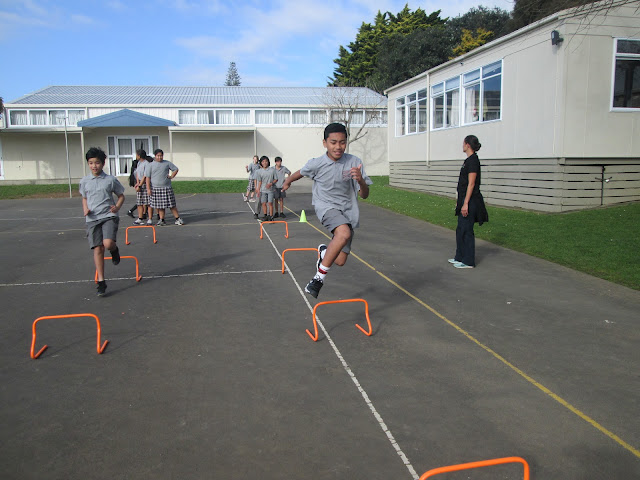
Learning to Sprint by Halatoa


Today, we had our first session with Andy today. Run Jump Throw is mainly based on running. Andy taught us about the basic rules of sprinting, which are:
  • Standing Tall
  • Looking Straight Ahead
  • Light Feet
  • High Knees
  • Cheek to cheek with arm movements
We also had a relay and a race jumping over hurdles  between each other. Andy mentioned to us to never loo at the starter as this slows us down. Mrs. Anderson also filmed us to compare us. I am looking forward to our next session next week! 

Wednesday, 22 July 2015

Personal Connections to Hauora

To help us understand the concept of Hauora we looked at the personal connections we had by thinking about our families, ourselves and our communities.


Wednesday, 24 June 2015

Jerry Collins: Halatoa


Today I created a Google drawing about Jerry Collins who  lost his life with his wife in a car accident. We really hope his daughter gets better. This Google drawing is about Jerry Collins rugby career and where he studied. This is a positive contribution Google Drawing about Jerry Collins.

Friday, 27 March 2015

Congratulations Halatoa!


Congratulations Halatoa a certificate from Mrs Eeles for showing a positive attitude to learning. Well done and keep working hard!

Thursday, 26 March 2015

Malama Honua Celebrations


Sebastian, Anthony and Halatoa


Fine, Yvette and Sajiha


Paige and Jasmine


Courtney


Saruja and Linda


Evelyn


Raymond and Oh'Smar


Latham and DJae


Taikehu

Tuesday, 2 December 2014

Square Group's 3D Challenge


Today's challenge was to create 3d shapes using the same polygon on each face. Once this had been completed, and the process photographed, the groups were asked to work collaboratively to create a presentation (of their choice) to share their learning. No instructions were given... just hints like the one that reminded the groups to record all the questions they asked each other. This is all their own work and was confidently presented to the class to show their understanding. Great work everyone!


Friday, 17 October 2014

Jazmine, Shantay, Kyra, Halatoa, Jacob S & Juliano's Collaborative Paragraph


We live in the universe that is built up of many galaxies. Many solar systems make up a galaxy. In our solar system there is a Sun that shines bright in the day, but you can’t see it at night because the Sun only shines at a specific time. Our planet orbits around the sun on a 365 day axis. The further the planet away from the Sun, the longer it takes to orbit around the sun. The Solar System has 8 planets all together. The Sun is a star. Stars are actually light years away from our planet. Most stars are bigger than the sun. A group of stars is called a constellation. When we can’t see the sun at night because one side of the Earth is facing the moon.The moon is like a satellite because it orbits in Earth’s atmosphere. Over the past few years technology has changed. People have been sending out space probes and satellites to study other planets and the different suns. Satellites give us a clear understanding of planets. Space probes need to be built for the different  gravities on the planets. Astronauts are space explorers that go to planets after space probes.

Friday, 19 September 2014

Halatoa, Oh S'mar and Jacob S' Research

This aftertoon we presented a prezi to our class. It is about why Italians migrate to NZ, different celebrations and different foods.

Monday, 9 June 2014

Topic Challenge

Room 9's challenge was to find the answers to each of the three set questions then explain their findings in 25 words. They have done a great job of finding the facts and putting them into their own words.


What is Pollination?
Pollination is a process which pollen is transferred from the anther to the stigma of the plant. Thereby  it makes it possible to Fertilization  and reproduction.


Explain in 25 words that the role bees have in a plant reproduction?
Bees help plants grow. Without bees we wouldn’t get chocolate, coffee, bread and most other foods that we have today.  They help us alot.


Explain in 25 words how plant reproduction processes produce much of our food.
The plants reproduces more so than  before, because the bees have helped it grow  by transferring pollen from one flower to the female flowers stigma.


Kyra and Joshua


What is Pollination?
Pollination is when Pollinators (Bees,Moths,Butterflies) get pollen from an anther(Male) and transfer the pollen into the stigma(Female).


What role do bees play in plant reproduction?
Bees transfer pollen from a male flower into a female flower’s stigma.


Explain in 25 words how plant reproduction processes produce much of our food.
If this process didn’t exist we wouldn’t have foods such as fries that are produced by potatoes which need plant reproduction to grow.


Fine and Halatoa


What is pollination?
Pollinators (Bees etc.) collect pollen from plants and put pollen on other plants so they can grow. Without pollen there wouldn’t be plants and other things..

What role do bees have in plant reproduction
Bees fly to plants. They grab the pollen. Bees carry pollen to other plants. The pollen jumps on to the plant to help it grow.

How plant reproduction processes produce and much of our food
Plant reproduction is creating more plants. More plants mean more fruits and more food that grow in the ground to eat.

Saturday, 5 April 2014

Research Homework

Practising the skills of locating facts and summarising information in our own words is the homework focus this term, Enjoy reading the information we found out about the giant pandas.


Tamim


Faitele and Halatoa


Samantha and Oxsanah


Kapri

Tuesday, 11 March 2014

Explanation: What is Assessment? by Halatoa, Lani, Joshua, Efaraima, Donatalian, Piripi and Loti

The dictionary says assessment is the action of assessing someone or something. At school teachers use assessments to see what the students know and what they still need to learn. Are you aware that assessments used to be called tests. Things have changed since our ancestors went to school one hundred years ago. If you got lots of answers wrong you had to stand in the corner wearing a dunces cap to show everyone that you were that you got lots wrong in your tests.

At Panmure Bridge School we do assessments that tell us what level we are in Reading, Maths and Writing. We answer questions in Maths and Reading on our netbooks. Sometimes we do tests on paper like the IKAN test which tells us what we need to learn and achieve in Maths. It is easier to use our netbooks so we can delete any mistakes.

We do assessments so the teacher can help us with the questions we don’t know and this helps the teacher plan what we are going to learn. Making a mistake is ok because we can learn from each others mistakes.

Assessments help us learn new things and helps the teachers learn new things as well. Assessments show what level you’re at and what you still need to learn. Our marks let our parents know where they can help us with our learning at home.


Sometimes you do well and sometimes you make mistakes when you do assessments. You should always try your best and be focused on your work. Remember to read the questions carefully so that you answer the questions right.

Tuesday, 25 February 2014

Eastern Beach fotor collage: Halatoa


This is my Eastern Beach picnic fotor. I enjoyed going to Eastern Beach it was really fun because there were heaps of activities and we got to swim two time.